AWS Transcribe Pricing 2026: What $0.024/min Really Buys
AWS Transcribe's tiered per-minute rates, what the base price excludes, the hidden AWS costs around it, and when a flat-rate service is the saner choice.
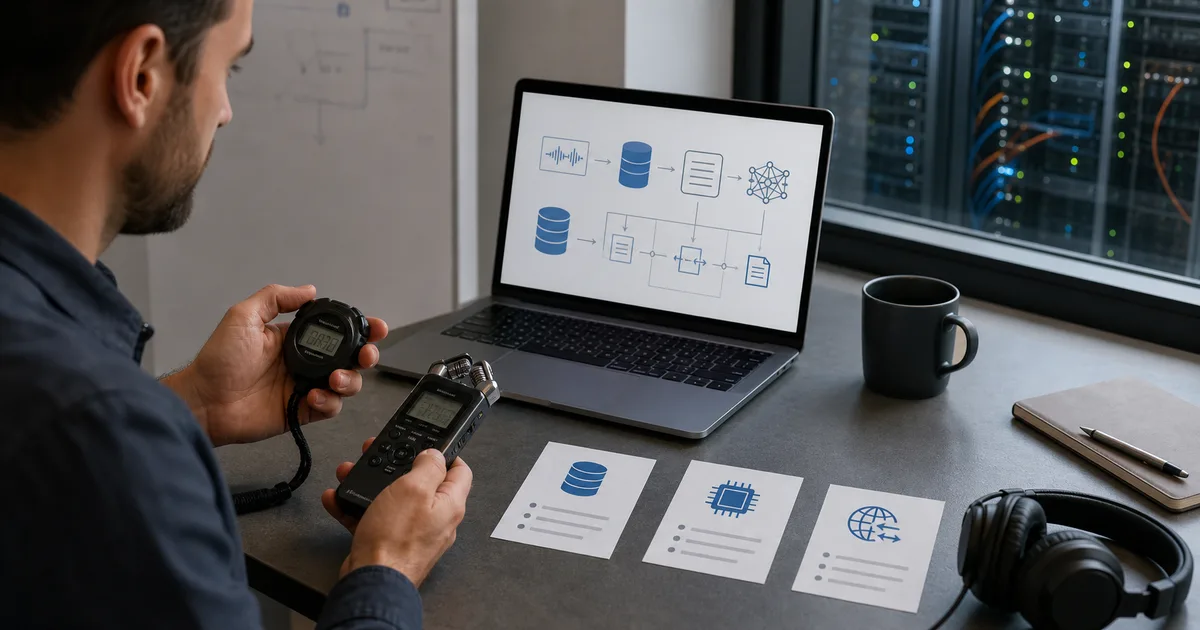
AWS Transcribe starts at $0.024 per minute ($1.44/hour) with volume discounts at scale and a 60-minute monthly free tier for your first 12 months. On paper that is cheap. In practice, the tiering, minimum charges, regional variation, and à la carte features mean most small users pay more than they expected — and do AWS integration work to get there. Figures below were verified from AWS's pricing page in mid-2026.
The tier structure
US East (N. Virginia), standard transcription:
| Tier | Monthly volume | Per minute | Per hour |
|---|---|---|---|
| 1 | 0–250k minutes | $0.024 | $1.44 |
| 2 | 250k–1M minutes | $0.015 | $0.90 |
| 3 | 1M+ minutes | $0.0102 | $0.61 |
Reality check: 250,000 minutes is over 4,100 audio hours per month. Unless you are running a product, you will live in Tier 1 forever. Regional pricing runs 20–30% higher outside US East, and billing is per-second with a 15-second minimum per request.
What the base price includes — and doesn't
Included: speech-to-text, punctuation, timestamps, broad format and language support.
Costs extra: speaker identification, custom vocabularies, custom language models, PII redaction. Speaker ID is the one that stings — most meeting and interview use cases need it, and it pushes the real rate up before you have transcribed a single file.
Hidden costs nobody warns you about
The per-minute rate is not the bill. A working AWS Transcribe pipeline also needs:
- S3 storage for input audio and output JSON (billed separately, forever, until you remember to delete).
- Data transfer charges for getting files in and out.
- Engineering time — IAM roles, SDK integration, job polling or EventBridge wiring, output parsing. The output is raw JSON; turning it into a readable document is your code.
For a developer building transcription into a product, this is all normal and fine. For anyone who just has recordings, it is a tax.
When AWS Transcribe makes sense
- You are already on AWS and transcription is a feature of your application.
- Your volume reaches the discount tiers.
- You need programmatic everything — automated pipelines, no humans clicking upload.
When a flat-rate service is the better choice
If your actual requirement is "turn these files into readable transcripts," TranscribeBee is $2 per audio hour with speaker identification, timestamps, and TXT/SRT/DOC/PDF export included — no AWS account, no JSON parsing, files auto-deleted after processing. Compared honestly: AWS Tier 1 plus speaker ID runs roughly $1.50–2.00/hour before storage and engineering time, so for low-volume users the all-in costs converge while the effort does not.
AI Prompt: AWS Transcribe True Cost Calculator
To model your scenario properly — volume, region, features, storage — use the AWS Transcribe True Cost Calculator prompt from our free AI prompts library. Paste in your numbers and it produces an all-in monthly estimate against flat-rate alternatives.

More Posts

Azure's $1/hour real-time and $0.36/hour batch rates look cheap until you add the surrounding Azure services. The real math, and when the lock-in is worth it.

Google's STT rate is fair and Chirp is included free — but the GCP pipeline around it (storage, functions, egress) is where the bill actually grows.

Per-minute, subscription, freemium, and enterprise transcription pricing decoded — what each model really costs per hour and which one fits your usage pattern.
Newsletter
Join the community
Subscribe to our newsletter for the latest news and updates