Healthcare AI Transcription: HIPAA Privacy Considerations
What HIPAA actually requires before any transcription tool touches PHI — BAAs, safeguards, and de-identified workflows that work without them.

Documentation consumes a large share of clinical time, and AI transcription can cut it substantially — but in healthcare, the compliance evaluation comes before the productivity math. This is an educational overview of what to check before any transcription tool touches Protected Health Information (PHI). It is not legal or compliance advice; run any implementation past your privacy officer.
The critical disclosure up front: TranscribeBee does not currently offer Business Associate Agreements (BAAs). HIPAA-covered entities handling PHI must use transcription services that sign BAAs. Where TranscribeBee fits in healthcare-adjacent work is covered below — for PHI itself, use a BAA-providing vendor.
What counts as PHI in a transcription context
More than people expect: patient names and identifiers, but also diagnoses, treatments, medications, appointment dates, provider names, facility details, and record numbers. A casual dictation about "Mrs. Alvarez's diabetes follow-up on Tuesday" contains PHI three times over. If a recording contains any of it, the full HIPAA framework applies to every system that processes the file.
What HIPAA requires of a transcription vendor
- Technical safeguards (45 CFR §164.312): encryption in transit and at rest, access controls, audit logs, and enforced data-retention limits.
- Administrative safeguards (§164.308): a signed Business Associate Agreement — non-negotiable for any vendor processing PHI — plus staff training, incident-response procedures, and documented risk assessment.
- Physical safeguards (§164.310): secured processing environments and device controls.
When evaluating any vendor, the four questions that sort the field fast: How long are files retained? Is deletion automatic? What encryption is used in transit and at rest? Will you sign a BAA? A "no" on the last one ends the conversation for PHI use, whatever the other answers.
Where AI transcription helps without touching PHI
Plenty of healthcare-organization audio contains no patient information, and standard tools work fine there:
- Administrative and operations meetings
- Training sessions, grand rounds, and lecture content
- Research interviews conducted under de-identification protocols (with IRB sign-off on the workflow)
- Vendor calls, board meetings, and strategy sessions
For this tier, TranscribeBee applies the privacy posture you would want anyway — files auto-deleted after processing, no human review of content — at $2 per audio hour. The discipline that makes the two-tier approach safe: a written rule about which recordings may go to which service, and training so nobody uploads a clinical dictation to the wrong tier.
AI prompts for clinical documentation
Our free AI prompts library includes two healthcare-specific prompts, built for use inside whatever compliant environment your organization has approved:
Prompt 1: Patient Encounter Clinical Note Generator
Structures an encounter transcript into chief complaint, HPI, exam findings, assessment, and plan, for clinician review and signature. Use only with transcripts produced inside your compliant stack.
Prompt 2: Medical Terminology Accuracy Checker
Scans a transcript for likely speech-recognition errors in drug names, dosages, and clinical terms, flagging them for human verification. Catches the "metoprolol/metoprolol succinate" class of error that generic cleanup passes miss.
The implementation order that works
- Classify your audio: PHI vs. non-PHI, in writing.
- For PHI: shortlist only BAA-providing vendors, then evaluate accuracy and workflow.
- For everything else: optimize for speed and cost.
- Document the policy, train the staff, audit occasionally.
The productivity gains are real, but they are claimed by organizations that did the boring classification work first.

More Posts
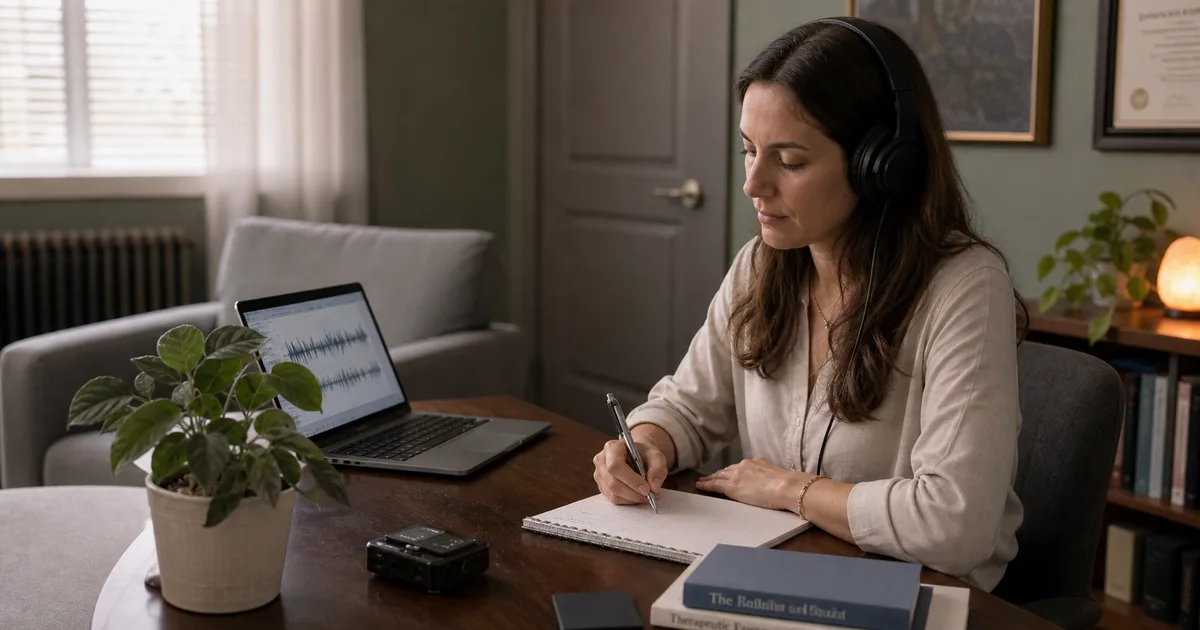
Therapists spend 6–8 hours a week on notes. How session transcription cuts that ethically — consent practices, privacy boundaries, and two clinical prompts.

No state requires verbatim transcripts of public meetings — they require minutes. How clerks use AI transcription to draft better official records, compliantly.

Verbatim vs intelligent verbatim, formatting for NVivo and ATLAS.ti, member checking, and AI prompts for thematic analysis — a complete research workflow.
Newsletter
Join the community
Subscribe to our newsletter for the latest news and updates