SEO Article Series from One Transcript: The AI Prompt
Turn one long recording into an interlinked article cluster — the prompt that maps sub-topics to keywords and drafts the series plan.
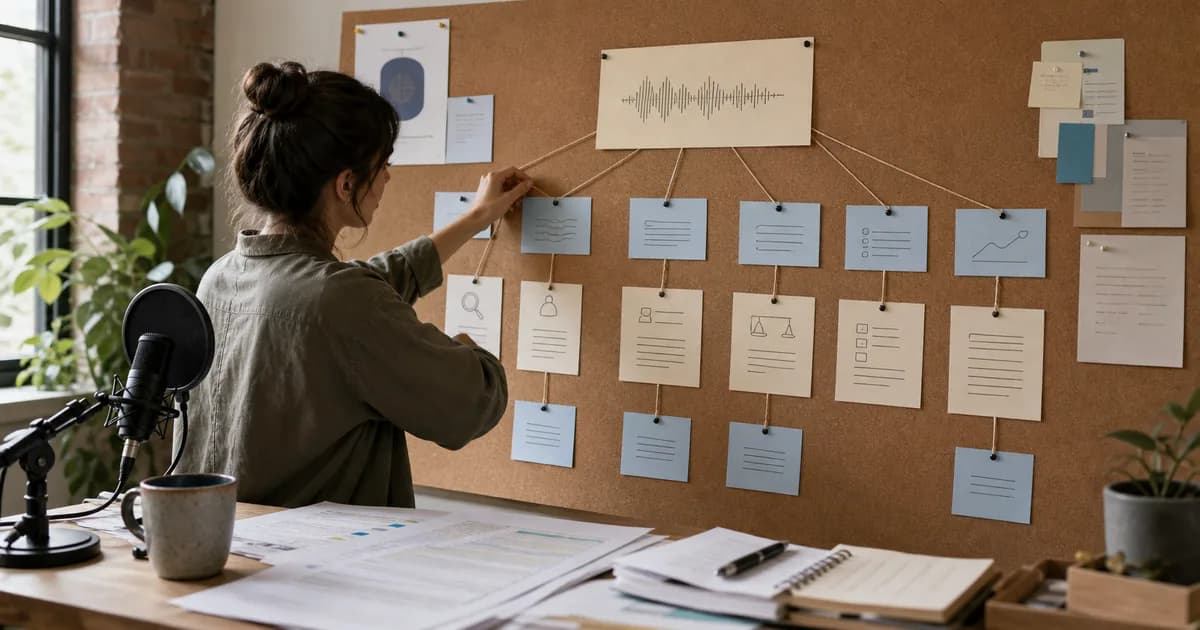
A 60-minute webinar is not one article — it is four or five, each targeting its own keyword, interlinked into a topic cluster. This prompt does the mapping: sub-topics, target keywords, article outlines, and the linking plan.
The Complete Prompt
Analyze this comprehensive transcript and create a strategic content series plan:

## Content Series Overview
- Main theme/topic cluster
- Target keyword strategy
- Internal linking opportunities
- Content progression from basic to advanced

## Individual Article Outlines (5-7 articles)

For each article, provide:

**Article [#]: [Title]**
- Primary keyword target
- Word count recommendation (800-2000 words)
- Key points to cover
- Target audience level (beginner/intermediate/advanced)
- Internal linking opportunities to other articles in series
- External reference suggestions
- Meta description (150-160 characters)

## SEO Strategy
- Keyword clustering approach
- Content hub structure
- Pillar page recommendations
- Featured snippet opportunities

## Content Calendar
- Publishing sequence for maximum SEO impact
- Seasonal considerations
- Promotion strategy for each piece

Transform the insights from this transcript into this strategic content approach:

Evidence rules:
- Treat keyword ideas as hypotheses, not search-volume data.
- Do not invent traffic estimates, ranking difficulty, expert quotes, statistics,
  or external references.
- Map every proposed article to distinct source passages and a distinct search
  intent; merge articles that would repeat the same evidence.
- Mark claims that require research as [VERIFY BEFORE DRAFTING].

---
Prompt by TranscribeBee (transcribebee.com) – Professional AI transcription with professional-grade accuracy.
---

[PASTE YOUR TRANSCRIPT HERE]
Step-by-Step Implementation
- Transcribe the long-form source — webinar, panel, training session, multi-topic interview (TranscribeBee, TXT export).
- Run the prompt for the series plan — review the proposed split before drafting; merge thin sub-topics, drop off-strategy ones.
- Draft one article per run: "write article #2 from the plan, using the relevant transcript sections" — full attention per piece beats one mega-run.
- Publish on a schedule with the interlinks in place; clusters compound as the pieces index.
Validate the plan before drafting
The transcript proves that you have source material; it does not prove that every proposed keyword has demand. Put the plan into a review sheet with one row per article: intended reader, search intent, source timestamps, primary query, existing page that might compete, and evidence still needed. Validate query language with Search Console, a keyword tool, customer questions, or sales conversations before writing.
Drop any outline that cannot answer "what will this page contribute that the current search results do not?" Google's guidance favors substantial, original, people-first content over pages produced mainly to capture search visits; use its helpful content questions as the final editorial gate.
Customization Options
- Keyword discipline: paste your existing target list so the series complements rather than cannibalizes current rankings.
- Pillar + spokes: ask for "one comprehensive pillar article plus 4 supporting pieces" for classic cluster architecture.
- Search intent split: request informational vs comparison vs how-to framing per piece.
- Internal link targets: list 5 existing URLs you want the series linking into.
FAQ
How long must the source be? 40+ minutes of substantive content typically supports 3–5 articles; under 20 minutes is one article, not a series.
Won't the articles overlap? They can. Compare intent, evidence, and proposed headings before drafting; merge two outlines when a reader would reasonably expect one page to answer both.
Does Google penalize AI-derived content? Google's stated position targets unhelpful content, however produced. Transcript-derived articles carry your actual expertise — edit for accuracy and voice, and they're as legitimate as any ghost-written piece.
Cadence? Use a schedule your editorial team can review properly. Search engines do not require a particular cadence, and adding content merely to make a site look fresh is not a ranking strategy.
Measuring success? Track each page and the cluster in Search Console: indexing, queries, impressions, clicks, and whether pages compete for the same terms. Consolidate when two pages repeatedly surface for the same intent without adding distinct value.

More Posts

Blog posts, meeting summaries, social packages, training modules, SEO series, FAQs, and executive briefs—seven prompts, each under five minutes per deliverable.

One 30-minute video holds 3–5 blog posts, 20+ social posts, and a newsletter. The transcription-first pipeline that gets them out in hours, not days.

Why every episode needs a transcript — SEO, accessibility, repurposing — plus the workflow and three prompts that turn audio into show notes and posts.
Newsletter
Join the community
Subscribe to our newsletter for the latest news and updates