AssemblyAI Pricing 2026: Why $0.15/hr Becomes $0.35/hr
AssemblyAI's base rate covers transcription only — speaker ID, sentiment, PII redaction and summarization all stack on top. Here is the real per-hour math.
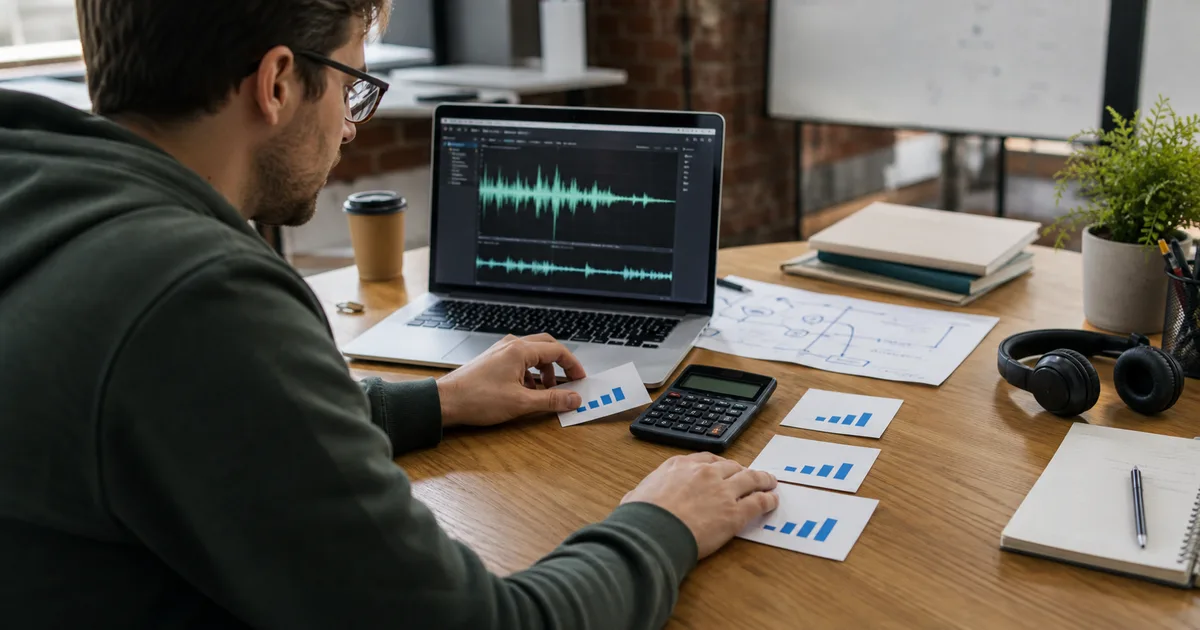
AssemblyAI's pricing looks simple: $0.15 per audio hour for the Universal speech-to-text model. What the headline number hides is that every advanced feature is priced separately — and the add-ons stack quickly.
Speaker identification is +$0.02/hour. Sentiment analysis, +$0.02. PII redaction, +$0.08. Summarization, +$0.03. By the time you enable what most applications actually need, the base rate has doubled or tripled. All figures below were verified from AssemblyAI's pricing page in mid-2026 — note that in-region processing rises 10% from July 2026 (global routing keeps current rates), so confirm before committing.
The base rates
| Model | Per hour | Use case |
|---|---|---|
| Universal (pre-recorded) | $0.15 | Standard batch transcription |
| Universal-3 Pro | $0.21 | Higher-accuracy model |
| Universal-Streaming | $0.15 | Real-time |
Competitive — until you start adding features.
The feature stacking problem
Each capability is a separate line item per audio hour:
| Add-on | Per hour |
|---|---|
| Speaker identification | $0.02 |
| Sentiment analysis | $0.02 |
| Key phrases | $0.01 |
| Custom formatting | $0.03 |
| Summarization | $0.03 |
| Entity detection | $0.08 |
| Auto chapters | $0.08 |
| PII redaction | $0.08 |
| Topic detection | $0.15 |
A realistic product stack — transcription + speaker ID + entity detection + PII redaction — lands around $0.33–0.35/hour, more than double the advertised rate. Enable topic detection and you have tripled it. None of these numbers are large in isolation; the trap is that you discover which features you need after you have built against the API, when each addition silently raises your unit cost.
Who AssemblyAI is actually for
AssemblyAI is a developer API, and a good one. The à la carte model is rational if you are building a product, know exactly which features you need, and can do volume math across millions of minutes. The free tier ($50 in credits) and volume discounts at scale reinforce that.
It is the wrong tool if you just need transcripts:
- There is no upload interface for end users — everything goes through the API.
- Feature stacking makes cost prediction genuinely hard for small teams.
- You own the engineering: retries, webhooks, file handling, format conversion.
When simplicity wins
If you are a person with audio files rather than a product with an audio pipeline, an all-inclusive service is cheaper in total cost. TranscribeBee charges $2 per audio hour with speaker labels, timestamps, and TXT/SRT/DOC/PDF export included — no API integration, no per-feature math, files auto-deleted after processing.
The honest framing: $2/hour is more than AssemblyAI's $0.35/hour stacked rate. What you are paying for is zero integration work. If you transcribe 10 hours a month, the difference is $16.50 — far less than the engineering time an API integration costs. If you transcribe 10,000 hours a month inside a product, build on the API.
Estimating your real AssemblyAI bill
Before deciding, run your scenario through the AssemblyAI Cost Calculator prompt in our free AI prompts library — it walks through which add-ons your use case needs and computes the stacked per-hour rate against alternatives.

More Posts

Per-minute, subscription, freemium, and enterprise transcription pricing decoded — what each model really costs per hour and which one fits your usage pattern.
Deepgram Nova-3 runs $0.0043/min batch and $0.0077/min streaming. The real decision is which you need — and whether you need a developer API at all.
OpenAI's Whisper API costs $0.36/hour; self-hosting starts around $861/month all-in. Where the break-even really sits and who should choose what.
Newsletter
Join the community
Subscribe to our newsletter for the latest news and updates