Therapy Session Transcription: Privacy & Documentation Guide
Therapists spend 6–8 hours a week on notes. How session transcription cuts that ethically — consent practices, privacy boundaries, and two clinical prompts.
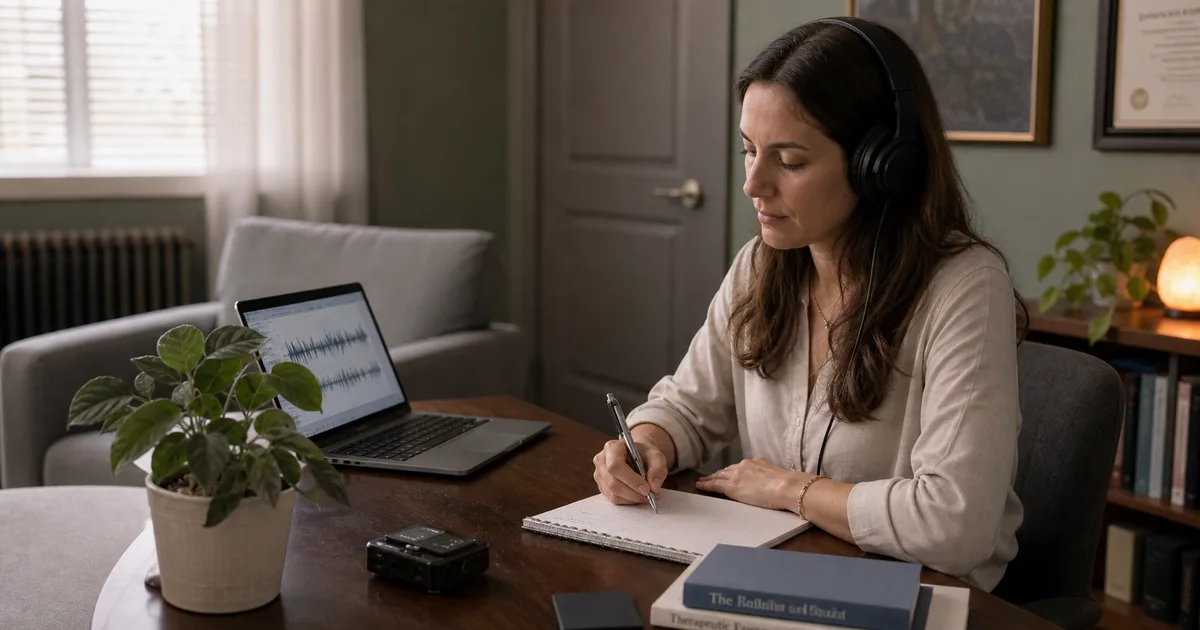
Therapists face a documentation paradox: more time on notes means less for clients. Clinicians spend roughly 35% of their time on documentation (JAMIA research) — for a therapist running 25–30 sessions a week, that is 6–8 hours of notes, written from memory after emotionally intense sessions, often with the next client waiting. The administrative load is a documented driver of burnout, and some clinicians cut caseloads just to keep up with paperwork.
Session transcription can relieve this — within strict privacy, consent, and ethical boundaries. Compliance note first: session recordings are PHI. HIPAA-covered providers need transcription vendors that sign Business Associate Agreements; TranscribeBee does not currently offer BAAs, so the workflows below describe the pattern — implement them with whatever compliant tooling your practice's privacy review approves. See our healthcare privacy guide for the full evaluation framework.
The ethical pattern
Practices using session transcription well follow the same shape:
- Explicit consent before any recording — with a clear, jargon-free explanation: audio is uploaded, transcribed by AI, audio deleted; the transcript informs the clinical note and is then handled per a stated retention policy.
- Genuinely voluntary — research on recording in psychotherapy finds most clients accept when the purpose is clear, but the power dynamic is real; the decline option must be easy and consequence-free, revocable any session.
- Transcript as reference, not record — the clinical note remains the clinician's 150–400-word professional synthesis. The transcript is working material for writing it, not a substitute for it.
The goal is better documentation, not surveillance — and that framing, stated to clients in those words, is what makes consent meaningful.
What transcripts genuinely improve
- Exact client language. "I feel like I'm disappearing" documented verbatim carries clinical information that "client reported depressive symptoms" loses. Transcripts preserve the words that matter diagnostically and therapeutically.
- Intervention accuracy. What you actually said, tried, and how the client responded — documented without reconstruction error.
- Memory load. Writing notes from a transcript reference takes minutes; reconstructing a 50-minute session from memory at 9 PM takes longer and loses more.
What transcripts are NOT for
Worth stating explicitly in any practice policy: not for verbatim notes (over-documentation creates clinical and legal exposure), not for sharing beyond clinical supervision channels, not a substitute for clinical judgment, and not retained indefinitely — a fixed, short retention window after the note is written, applied uniformly.
AI Prompt: Session Progress Note Generator
From our free AI prompts library: structures a session transcript into draft note components — presentation, client-reported content, interventions used, response, assessment threads, and plan — in standard 150–400-word note discipline. The clinician edits, verifies, and signs; the draft eliminates the blank page, not the clinical judgment. Run it only inside your approved, compliant environment.
AI Prompt: Supervision Case Summary
For supervision prep: compiles a case summary across session transcripts — themes, interventions and responses over time, risk-relevant content flagged, and questions worth supervision time. Pre-licensed clinicians report this is where transcription pays off most: supervision arrives prepared with evidence rather than recollection.
The privacy-first workflow
Consent on file → record → transcribe in the compliant environment → draft note with prompt → clinician finalizes → audio and transcript deleted per policy → only the signed note remains. Every arrow in that chain should appear in your written policy, and the deletion step is the one to automate — retention by inertia is how privacy incidents happen.

More Posts

What HIPAA actually requires before any transcription tool touches PHI — BAAs, safeguards, and de-identified workflows that work without them.

Verbatim vs intelligent verbatim, formatting for NVivo and ATLAS.ti, member checking, and AI prompts for thematic analysis — a complete research workflow.

How speaker diarization works, when it excels and fails, how to record for clean speaker separation, and how to map Speaker A/B labels to real names fast.
Newsletter
Join the community
Subscribe to our newsletter for the latest news and updates